

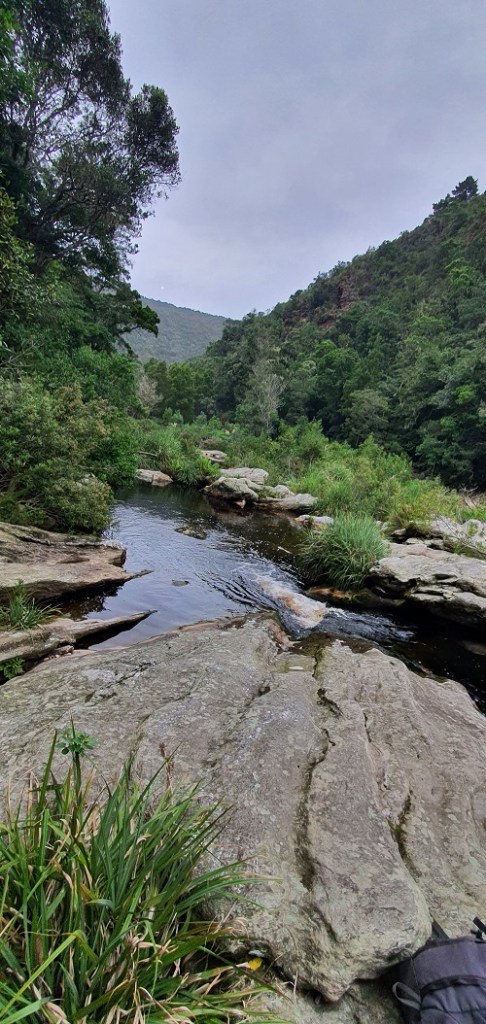
Photo: Susanne Hazen. Towerland.
As you have read in my previous blogs, I was in South Africa for the last few weeks. I spent time in Towerland (Langeberg mountains) and Wilderness, among other places.
This is one of the areas of the San – the oldest people in the world. They are descendants of the oldest people on earth. Recent genetic studies show that San genes date back to the oldest human genetic material in the world. And since Homo Sapiens – as far as we know now – migrated from southern and eastern Africa to other parts of the world – it could be that my and your distant, distant, distant ancestors walked here.
And I was allowed to walk on that ground. I experienced this as very special and healing. And it made me realize once again how humble we are.
Meet our distant ancestors.
Another online circle, Systemic Ritual, will be on Monday, March 11, 2024.
This time, we are going to meet our distant ancestors. Are you joining us? See:
Let me take you back to the centuries that preceded us.
The last word on the evolution of Homo Sapiens has not yet been said. But we know almost certainly that many hominins from different species preceded us and lived side by side for millions of years. And the origin of these hominids was, as far as we now know, in the south and east of Africa.
The oldest known hominid, Homo habilis, evolved about 2.8 million ago. H. habilis was the first known human species to use stone tools. The stone tools found in caves in South Africa may belong to Homo Habilis. And I got to touch it!!!
About 1.8 million years ago, Homo erectus, the ‘upright walking man’, appeared. H. Erecus spread through Africa and Eurasia. He lived on this earth for more than one and a half million years. (What do you think – shall we – the homo sapiens – come so far, or do we destroy ourselves soon enough?)
During those years, various ‘variants’ of Homo Erectus emerged. Homo ergaster is one of them. This one stayed in Africa. Homo Sapiens (us) evolved from this species about 200,000 years ago. And the home Sapiens has spread all over the world.
The San – descendants of the oldest people on earth
Back then, long, long ago, there was a woman named =Um-=um-Borose. She was our mother and she came from the sun.
Umum Borose, after her death, gives birth to children of the sun, the San people.
From: https://rozenbergquarterly.com/de-historie-van-de-san/
The San is a name for different population groups in South Africa, Namibia, Botswana, and Angola. They belong to the Khoisan. They simply call themselves ‘people’ or ‘real people’ in their own language.
The Dutch colonists called them ‘Bushman’. This name refers to the bushes among which they lived. The Dutch were not that friendly to them, by the way. In the early nineteenth century, most San were exterminated or expelled. As a result, due to a lack of examples, their knowledge of the petroglyphs and understanding of the medicinal properties of the vegetation disappeared.
The ancestors of the San were once the only people to inhabit the plains and mountains of southern Africa. They made petroglyphs that we can still find today. These petroglyphs are the first human art expressions.
They were nomadic tribes. They lived from hunting and from ‘veldkos’, an African word for everything that can be found and edible in and on the ‘field’. These are fruits, tubers, roots, nuts, seeds, honey, and ostrich eggs.
The San did not live anywhere permanently. There were areas and places where they kept coming back, including safe places in caves or fields with a few simple grass huts and a fire. As hunters, they had to follow the migration of wild animals in the dry season.
San culture was based on a high degree of equality. They were not fighters but lived according to the principle of giving and sharing. This principle allowed them to survive despite often harsh conditions.
When I draw my bow, I feel happy. It reminds me of the old days. We hunted and had a good life. Then, the white man came and took away our hunting grounds. He called us things from nothing. What kind of life is that? – Old Jacob Grandma.
From: https://rozenbergquarterly.com/de-historie-van-de-san/
Fynbos

Fynbos is the vegetation that you only find in the Cape region of South Africa. The Dutch colonists gave the name fynbos. The name refers to the thin trunks of the shrubs, which are unsuitable for construction wood.
The Cape Floral Kingdom is one of six flora kingdoms on earth. Although it is the smallest, it is the flora kingdom with the most diverse vegetation types.
The fynbos is – unfortunately – very ruined. Agriculture, wine growing and exotic plant species have largely displaced this original vegetation.
Numerous fynbos plants are already extinct, and more than a thousand species are threatened with extinction. Reserves are now designated to preserve and restore parts of the vegetation.
Many types of fynbos were used in traditional medicine by the Khoi San. Nowadays, this traditional knowledge is being researched. Unfortunately, a lot of expertise has been lost.
I did a tour with Branden in Wilderness. He is still starting up his company, but you can find him here: Branden Wilderness
I was impressed by his knowledge of ecology and the passion with which he is restoring the native vegetation on his property, in particular by removing non-native vegetation. I also learned a lot about natural medicines. It is a must-see and must-experience for anyone with a heart to take care of our planet and its ecosystem. And last but not least, visiting the cave where our ancestors lived for thousands of years was awe-inspiring.
Sources:
https://www.rmo.nl/museumkennis/archeologie-van-nederland/nederland-in-de-prehistorie/onze-voorouders/
https://www.rmo.nl/museumkennis/archeologie-van-nederland/nederland-in-de-prehistorie/onze-voorouders/
https://natuurwijzer.naturalis.nl/leerobjecten/hoe-heeft-de-mens-zich-over-de-wereld-verspreid
https://nl.wikipedia.org/wiki/Mens
https://rozenbergquarterly.com/de-geschiedenis-van-de-san/
https://nl.wikipedia.org/wiki/San_(volk)
https://www.capetown.gov.za/Explore%20and%20enjoy/nature-and-outdoors/mountains-and-hiking/focus-on-fynbos
https://nl.wikipedia.org/wiki/Fynbos
 Systemic Ritual and Systemic Constellations