
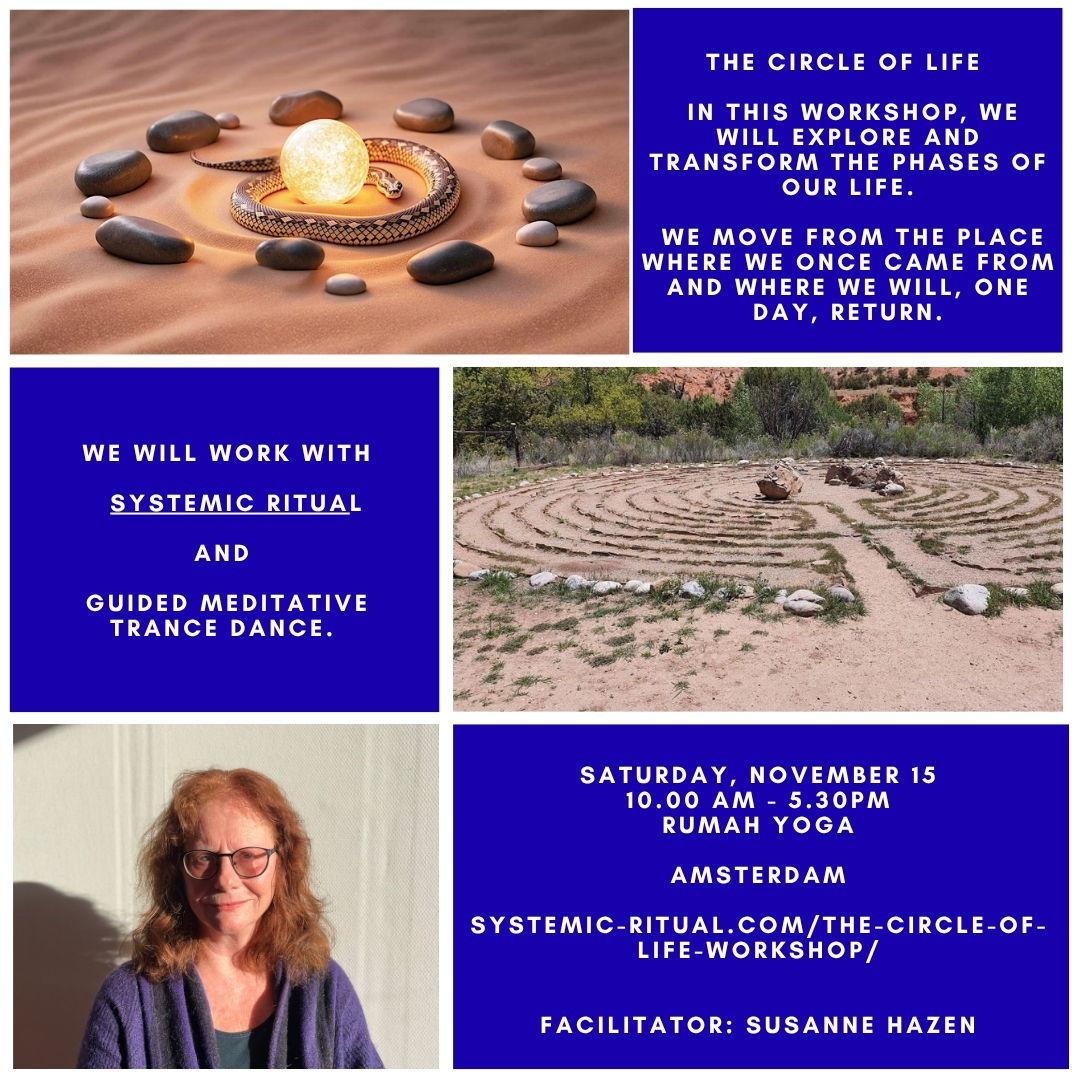
The Wheel of the Four Directions – also known in shamanic traditions as the Medicine Wheel – is an ancient model that reflects the cycle of life. It symbolizes the rhythms of nature, the phases of human experience, and the ongoing movement between birth, growth, decay, and renewal.
The Wheel offers a framework for working with the physical, emotional, mental, and spiritual forces of life, helping us to find insight, wisdom, and healing.
In this text, I focus on the Wheel of Life Phases.
The North – The Source of Wisdom and Origin
Our life begins in the Northeast, which means we come from the North.
But what is this place exactly?
The North is the realm where all experiences – yours and those of all souls who have had the courage to enter the wheel of earthly existence – are gathered.
Here, everything that has been lived, felt, and learned crystallizes into wisdom.
It is the place where all personal identity dissolves and only pure essence remains.
The North is the realm of both the departed and the unborn souls – the place of our ancestors.
We come from there, and we return there when our earthly cycle is complete.
From a shamanic perspective, children come not from their parents, but from their ancestors.
Parents provide the biological process, but the soul itself is sent from the North.
Conception takes place in the Northeast.
Here true magic unfolds: a soul transforms from a non-physical to a physical state, from a formless, timeless, non-polar space into a tangible, material reality.
It is an extremely delicate transition. Even today, the beginning of life reminds us how fragile this process is – a mystery never to be taken for granted.
It is also in the Northeast that the baby is born.
The East – Childhood
The East represents the phase of childhood.
It is the direction of new beginnings – of innocence, curiosity, and wonder.
Here, the child lives in openness, exploring the world freely, eager to discover and experience.
Just as the morning sun illuminates the earth, so does the light of awareness awaken within the child.
The Southeast – The Threshold of Adulthood
The Southeast marks the transition toward adulthood.
Roughly between the ages of thirteen and twenty-two, profound changes take place.
The body develops rapidly, the brain matures, and hormones stir inner turbulence.
It is a period of growth but also of confusion, emotional instability, impulsiveness, and strong mood swings.
The adolescent longs to explore the outer world.
This stage is vulnerable: young people do not yet see clearly what is risky and what is not. Taking risks stimulates the brain’s reward system – when something goes well, the excitement encourages further risk-taking.
Statistically, mortality rates peak in this life phase.
The central task of adolescence is the search for identity.
At some point, the family of origin begins to feel restrictive. The young person rebels, pushing against boundaries and claiming independence.
Yet this is not true individuality: the young person moves merely from the family soul to the group soul.
Friend groups take the place of family, each with their own rules, values, and limits.
The need to belong continues into adulthood.
We form circles of peers, parents at school, communities, or professional networks.
Belonging to a group is deeply human – we are tribal beings who thrive in connection.
Within a group we feel safety and strength, though belonging also implies exclusion.
There can be no “we” without “they.”
The dominant value in this phase is often loyalty, sometimes at the expense of integrity.
Eventually, the adolescent steps into the world of adults – into the South.
The South – Adulthood and Fulfilment
The South is the direction of adulthood – of strength, realization, and manifestation.
Here we take on responsibility as mature human beings.
We build a life: a home, a family, a career, a community.
We care for others and contribute to the continuation of life.
The South is the time of action and creation – the moment to harvest what was sown in the East.
It is a period of doing, achieving, and shaping ideals into tangible reality.
In this phase, we take our rightful place in the world, standing fully in the light of day, with open eyes and willing hands.
The Southwest – The Transition Toward Elderhood
The Southwest is the gateway to the West – the time of reflection, evaluation, and release.
Children leave the nest. The body begins to change. Energy shifts, and vitality now requires more care and maintenance.
For women, hormonal changes can be abrupt, often accompanied by physical and emotional discomfort.
The body softens, the familiar contours alter.
For men, the process is more gradual – testosterone levels decline, and energy subtly transforms.
The risk of chronic illness increases; the body reminds us that nothing lasts forever.
On a social and personal level, this is a time of reflection.
We look back on the choices that have shaped our lives – in relationships, work, family, and inner development.
We learn to accept what is, and to find peace with how things have unfolded.
This reflection can bring restlessness, but also serenity.
As children leave home, some experience emptiness, while others rediscover freedom.
If we look back with kindness, this phase can awaken a sense of generativity – the wish to share wisdom, teach, and guide.
Attention shifts from the self to the next generation.
The West – Maturity and Release
The West is the direction of the setting sun.
It is the time of completion, harvest, release, and wisdom.
Here we recognize impermanence – that all things belong to a greater rhythm.
Those who have lived with an open heart can find peace in this phase.
There is room for gentleness, compassion, and a deep sense of connection.
The West invites integration – bringing together all that has been, allowing it to transform into something new.
The Northwest – Elderhood and Return
From the West, we move gradually toward the Northwest – the phase of elderhood.
We withdraw from the world of doing and turn toward being.
Life slows down, and simplicity becomes meaningful.
In this final stage, we look back upon our life.
If the journey has been good enough, a sense of integrity and wisdom emerges – not regret, but fulfillment; not struggle, but peace.
The Northwest prepares the way back to the North, where we return to the greater whole – completing the circle once more.
The Circle Completed
The Wheel of the Four Directions reminds us that everything moves, everything changes, and everything returns.
Each direction, each phase, carries its own wisdom and teaching.
By aligning ourselves with the rhythm of the Wheel, we come to recognize the natural flow of life – from beginning to end, from birth to return.
In understanding these cycles, we find not only insight but also peace:
the quiet knowing that nothing is ever lost – only transformed.
 Systemic Ritual and Systemic Constellations