First, I wish you already a very happy New Year with lots of health, well-being and great challenges.
A look back at 2023
I look back on a pleasant, adventurous and full year of 2023, where I could fully practice my passion – systemic and shamanistic work. There were no fewer than ten groups for the Systemic Ritual course (online and live); I could give modules in Family Constellations for students at Innerlife Educations. I experienced enormous growth in the one-on-one consultations in my practice, and the advanced group grew!
So, I gained a lot of new inspiration in 2023, and YOU will notice that in 2024! Because, of course, I will integrate all these new insights and methods into my work.
What drives my work? My top 5!
“Curiosity about people and life as a whole.” “The inner movement from problem to strength.” “Interest in the inner processes that people go through.” “Research into ancient healing methods and their synthesis with contemporary methods.” “Love for life and for everything that lives.”
By popular request, there will again be ‘separate’ online circles in Systemic Ritual. Join me and inspire me with your questions or themes you would like to bring up. The first workshop of the year will be around: Bye bye 2023, hello 2024.
Based on the experiences gained with the modules of the Systemic Ritual course, I have improved the design of this course! More time to undergo rituals under my guidance and more time to practice together! See: /working-with-systemic-ritual/
Not planned yet, but definitely coming – a series of ‘Meetings with your ancestors‘ – based on all the new inspiration I have gained. This will be a series of consecutive workshops with beautiful(new)rituals, movement, and music.
In addition, the advanced group continues as usual, AND more opportunities have been created to participate – especially for people who live a little further away from Amsterdam or prefer the day instead of the evening. See: /systemic-ritual-en-sjamanisme-gevorderde-groep/
In the article ‘Soul loss and soul retrieval’, I wrote about soul parts that have separated from our body and personality at some point in our life. Such a secretion leaves a void, a reduced vitality. Systemic Ritual is one of the methods to get back in touch with those parts and let them come back – if desired.
And what happens after a ritual in which soul parts are retrieved?
After a soul retrieval, you often hear people say that they feel ‘more present’, ‘lighter’, ‘more alert’, ‘less dreamy’ and ‘stronger’.
If you want to learn more about Systemic Ritual and working with the concept of the Soul: See:
Often people also report that they perceive colours more clearly, hear better, and smell better. In short, the connection with the physical body has been improved. This can cause slight disorientation for a few days. The ‘healing’ has yet to settle down and find a place.
You often also hear these ‘side effects’ after a family constellation. Breaking free from an entanglement with a parent or ancestor, with which the method of family constellations works, is somewhere also a form of ‘retrieving a part of the soul’. A soul part, held by an entanglement, could not be fully present in the here and now because it was too closely connected with the trauma of that (ancestor) parent. In that context, this part was on the other side. When the entanglement is broken, that soul part can retake its place in the here and now, in the body/personality of the client.
Be careful
People are often more emotional after a soul retrieval. With the retrieval of the lost soul part, sooner or later, the memory of the event that made the soul part ‘flee’ may also return. That is why you must also be careful with retrieving soul parts after major trauma. The soul part that has thus gone ‘to the other side’ cannot simply be ‘placed back’. There will first have to be some form of healing of this soul part before returning to the client. The soul part may even have to be taken to a ‘healing place’, a kind of spiritual hospital to receive care and healing there before returning.
In addition, the client must also be strong enough to ‘handle’ and ‘care for’ the soul part that is being retrieved. A client must therefore have sufficient strength to receive the soul part again. It must be safe enough for the soul part to return.
Welcoming little Susanne
After retrieving a soul part, feelings of happiness, sadness, or anger can arise. These feelings could have to do with the lost soul part, and the process of remembering and integrating has to start. And that can take quite a while.
I came across the little two-year-old Susanne in a visualisation during one of my ‘retrievals’ (it is not strange to be allowed to undergo several ‘retrievals’). I saw images of her in a beautiful forest with sweet cats, horses, birds, lots of flowers, extensive lawns, streams with clear running water and even two gnomes – Bop and Mieke as the little Susanne called them. The little Susanne had “hidden” in this beautiful place. And no – she didn’t want to come back. Several times – spread over a few weeks – I had to visit her, become friends with her calmly and convince her that it was also very nice to come back to the here and now, in my body, in my personality. She eventually did.
Welcome home, little Susanne
Then for days, I felt a wave of enormous anger towards my mother and towards my oldest brother. I could skin them. I was sure it had to do with little Susanne and talked to her. I asked her what was going on. That’s when the memory came to me. I was two years old, and my brother (5 years old at the time) was playing with me, but it got out of hand. He put a pillow on my face and lay on top of it. I choked, I choked. Then, after a few moments, my little body managed to throw him off me with unprecedented force. An unparalleled power of a small body – it managed to survive. I saw my brother startled and he ran away.
I realised this, back then, was the moment a piece of my soul left. I felt panic and fear rise in me. And then anger – I was furious with my brother and my mother. My brother for what he had done and my mother for not taking good care of her children. Where was she?
I told little Susanne that she’d survived, that she’d been strong enough to throw brother off her. And that these kinds of things are not nice, but can happen and that you can not blame a little boy of 5 years.
These words turned out to be completely wrong. This was not what the little Susanne wanted to hear. This did absolutely no justice to her feelings. These words were disrespectful, lacking in empathy – completely bypassing her feelings of fear, panic, anger and sadness. These words made her return to her safe haven with Bob and Mieke in the woods.
Again I had to find her there. This time I stayed with her, feeling the fear again; we relived the panic, cried, and cursed on brother and mother. We managed to thank the unparalleled strength that appeared back then. We realised it wasn’t ‘I’ who managed to throw off my brother – it was my body’s survival instinct that managed to do that.
These emotions persisted for several weeks. My brother should be glad he didn’t call or meet me in these weeks. I would have given him the full blast of anger.
Integrate
After a ritual in which soul parts are retrieved, you are not done yet. A piece that has been separated from you for years needs time to integrate. That part needs all your attention, wants to be heard, seen and respected. That can be done in different ways.
As I described above, you can regularly start a conversation with the retrieved soul part. If you don’t have experience with this, find a therapist who can help you.
Pampering yourself is also a suitable method. The soul part has left because of a lack of joy, safety, etc. Show this soul part that there can now be joy, safety by undertaking things that underline this.
Bodywork – massage, emotional bodywork, shiatsu, acupuncture – methods that get the “chi” flowing again can be of great help too. Traumas are stored in your body. When a soul part is back, your body can also adapt, and physical blockages can finally be released with a little help from a therapist.
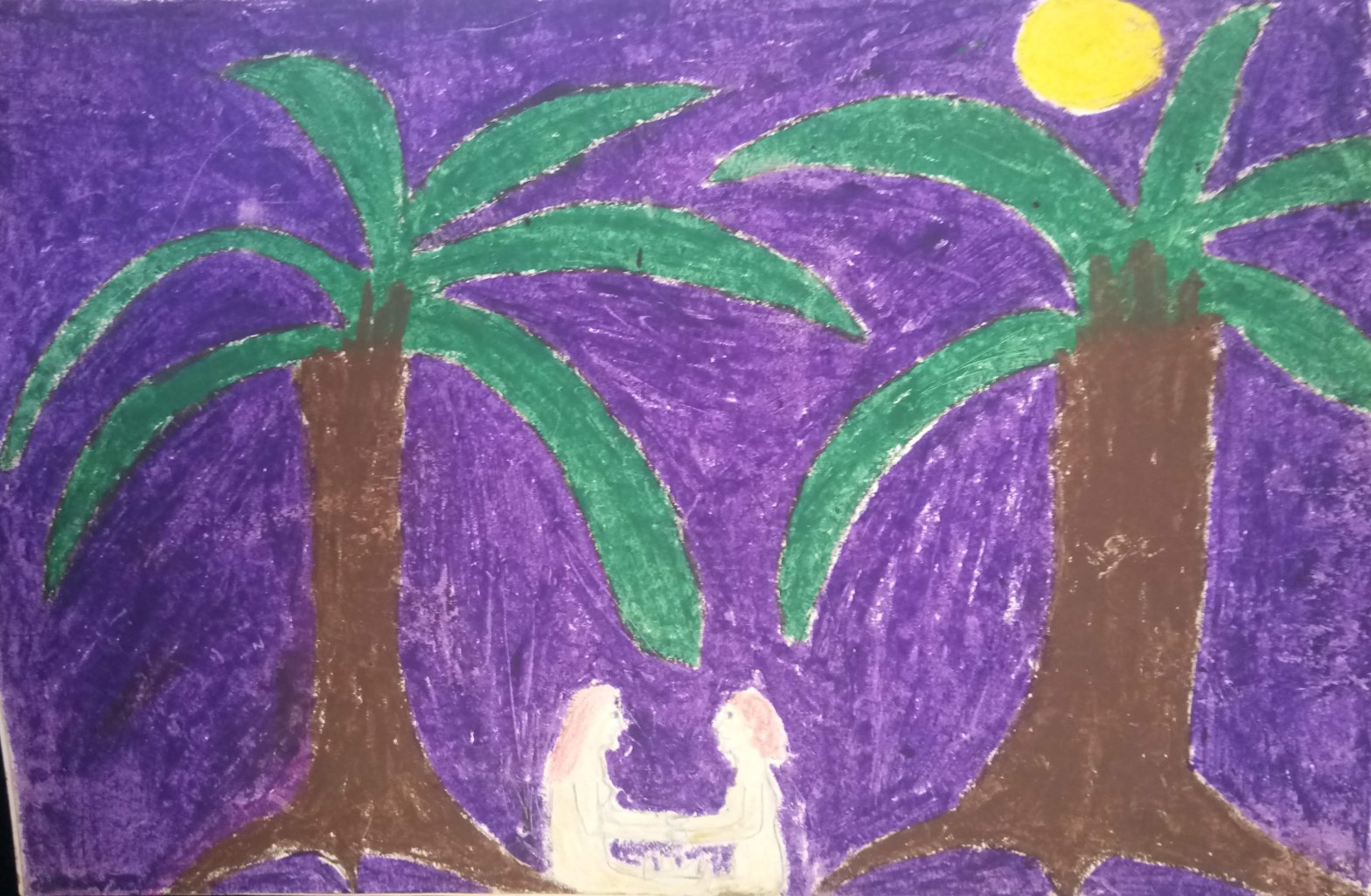
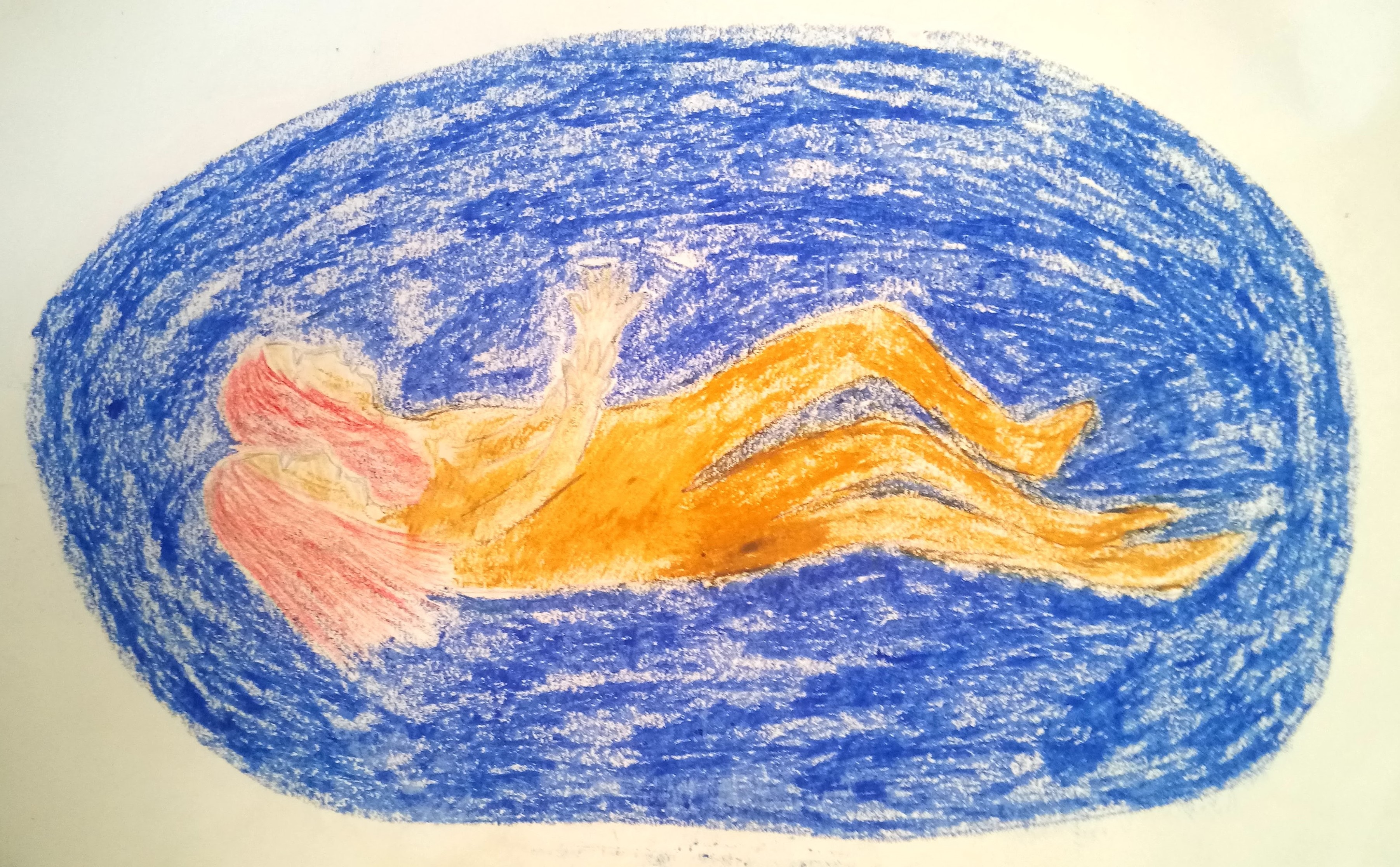
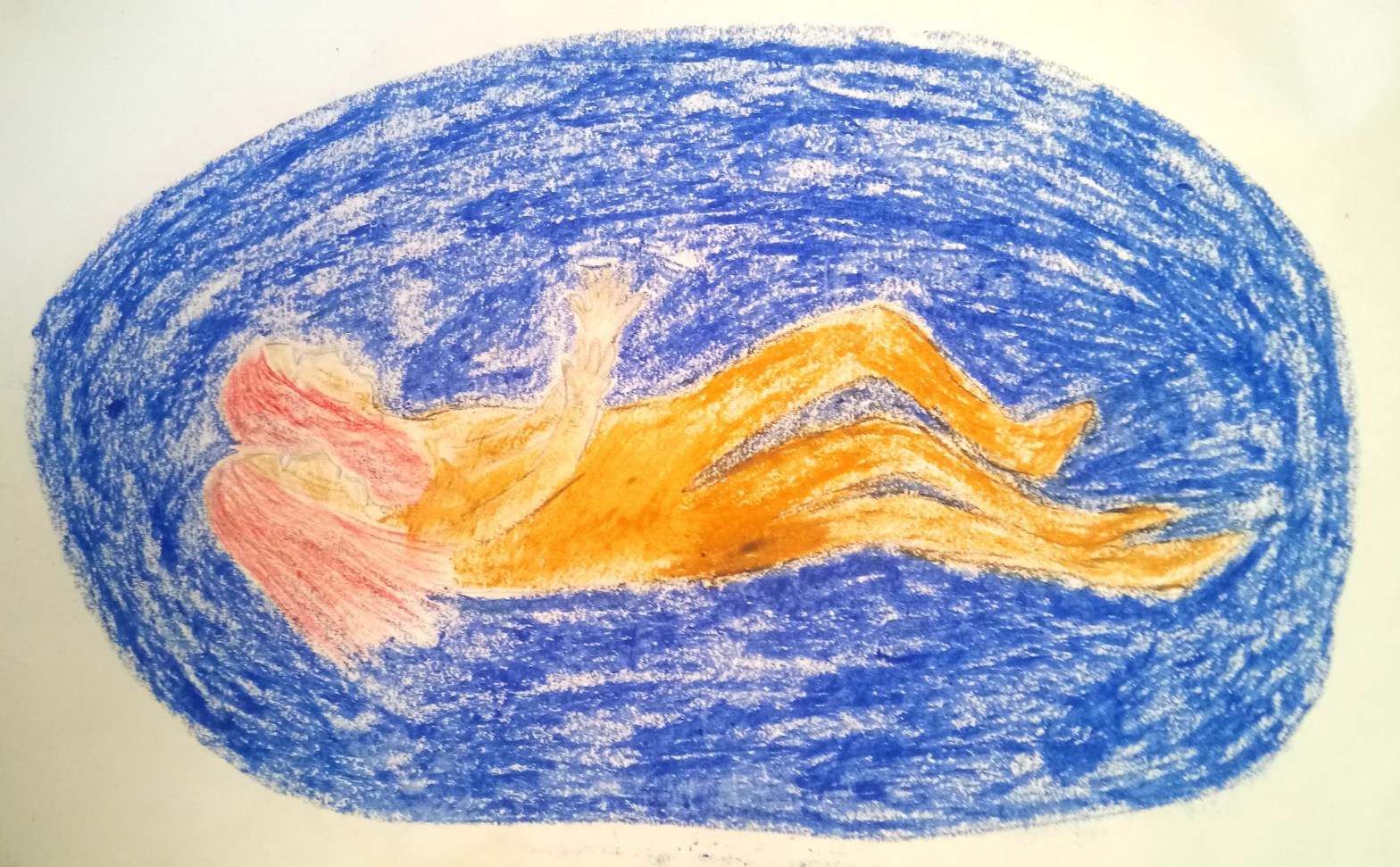
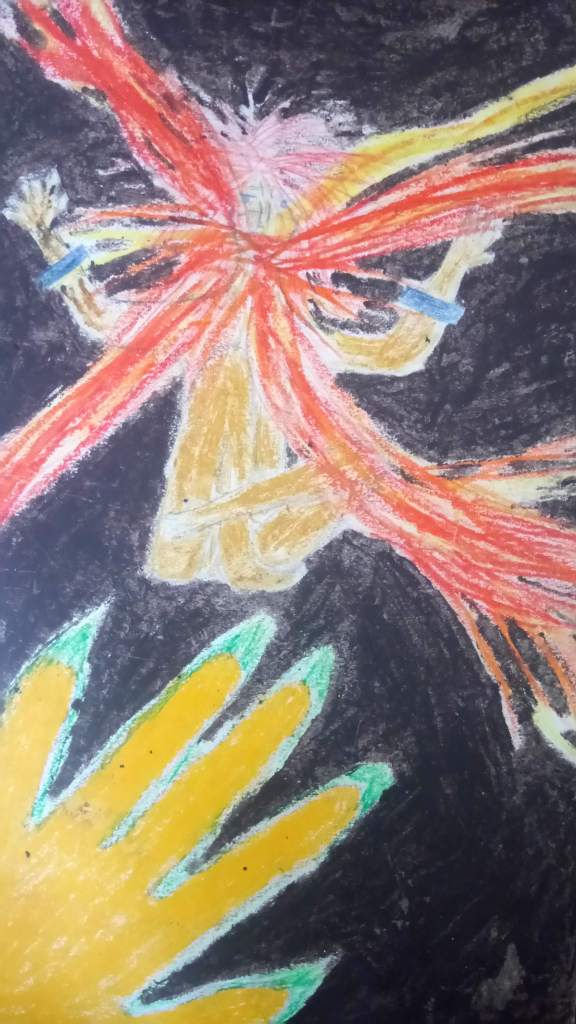
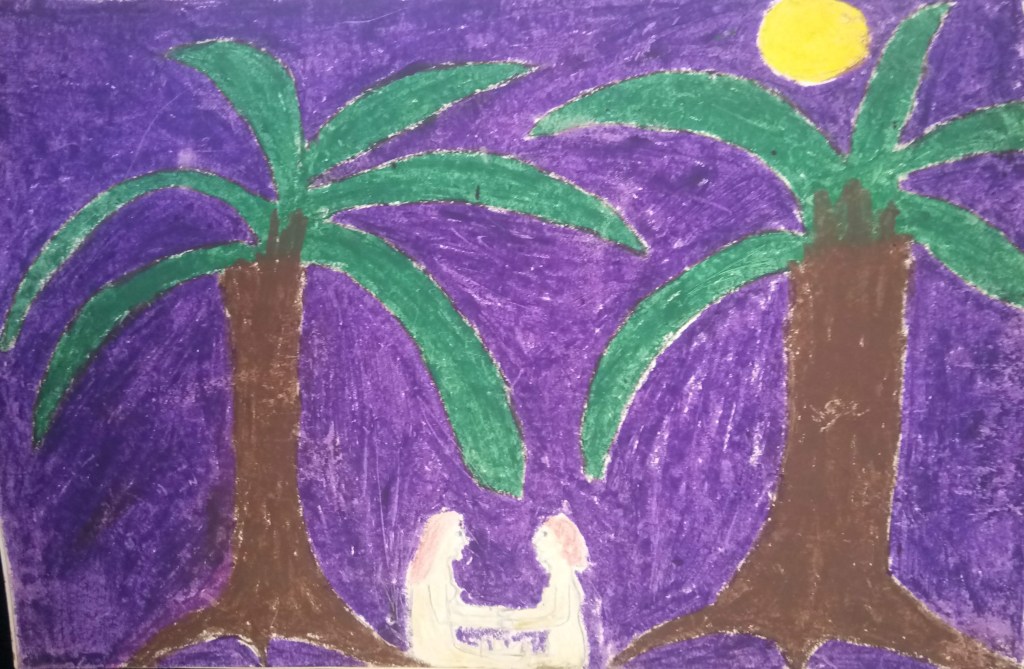
Drawing – the drawings in these articles are my own. After a return of a soul part, I created these – completely intuitive. One drawing shows what I felt. I felt as if a ‘body’ sank into me. The other drawings show how I took care of the soul part – by travelling with it regularly – in visualisations – to a safe, beautiful and warm place to have quality time together.
After severe trauma, the first thing to do is consult a psychotherapist or psychologist until there is enough strength to do a session in which soul parts are retrieved. After that, a therapist can again be helpful to integrate the retrieved soul part.
Inspired by:
Ingerman, S. Soul Retrieval. Mending the Fragmented Self.
In shamanistic traditions, it is stated that parts of the soul can separate from us and that this separation, this loss of soul parts, can be a cause of physical and mental illness. In this context, by soul, I mean an intangible part of our being that gives us vital energy and houses emotions, memories, feelings, sentiments. (This idea of the soul is similar to the concept of the astral body – as described in the article “The Five Bodies”)
If you want to learn more about Systemic Ritual and working with the concept of the Soul: See:
Lost parts of ourselves mean that we experience less energy/vitality because there is less ‘spirit’ in us due to the loss. A ‘full soul’ is fully present, clear, radiant. We unconsciously try to regain the lost parts through dreams, daydreams, quests for healing, spiritual disciplines, and by creating relationships with others that repeatedly mirror our lost soul parts. This search requires a lot of energy, while we already lack power because we have lost parts.
Parts of the soul can be lost due to various circumstances. These do not always have to be extreme circumstances.
Examples through which soul parts can ‘depart’ are:
You are too busy and lose sight of your soul
The soul gets bored because you “don’t live it.”
Souls can get jealous and then go to a ‘better place.’
Difficult situations “It’s not fun here anymore, so I’m going to a better place.”
Trauma, including abuse, loss of a loved one, miscarriage, abortion, surgery, accident
Sudden and extreme shock/fear
Parts of the soul can also be ‘stolen’ by someone else.
Symptoms or expressions of soul loss are:
Lack of vitality and connection with life
The feeling of being ‘absent’ after, for example, the death of a loved one, an accident or after an operation – the feeling of still being a bit in the anaesthesia
Feeling after a divorce that ‘a part of you is still with the other person.’
In shamanism, there are methods to bring the lost soul parts back to the person. This technique is called soul retrieval. Also, with the Systemic Ritual method, we can contact lost soul parts and help bring them back. After a soul retrieval, you will experience more connection with life, the earth, yourself and others.
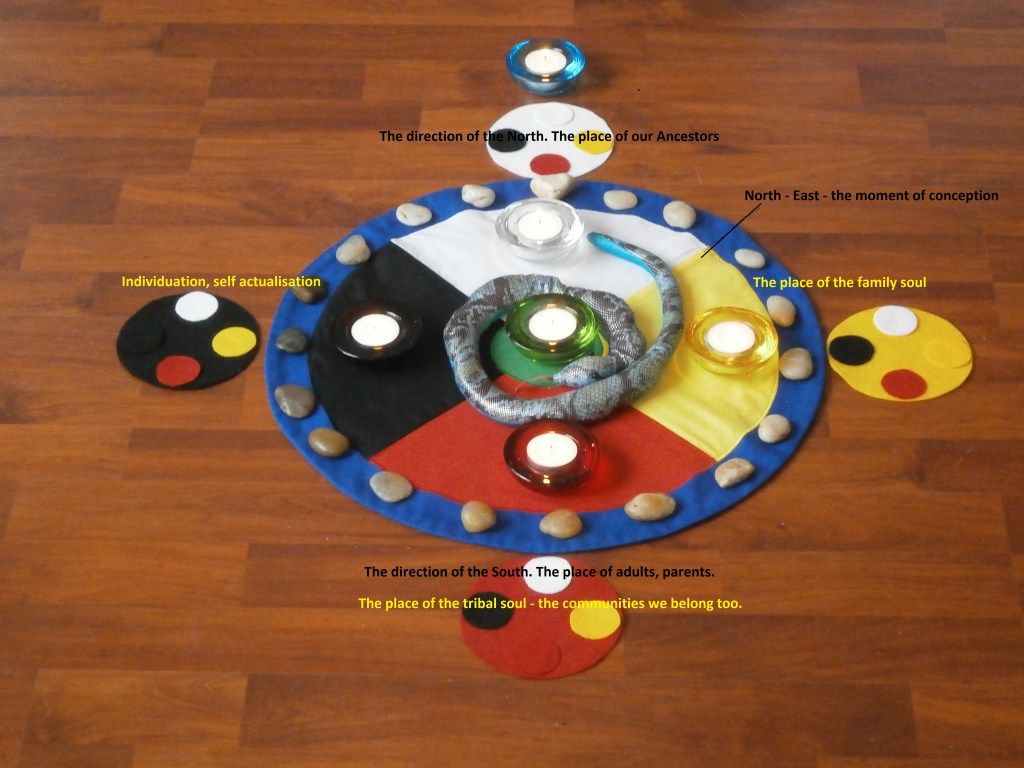
In the article “The Multiple Soul”, you have read that shamanistic traditions assume multiple souls. In my work, I distinguish the family soul, the tribal soul, the individual soul, and the universal soul. You can give the souls a place on the Wheel of the four directions, and the Wheel tells something about the development.
The Family soul
A baby cannot be born without a father and a mother. With this fact, the baby becomes a member of the family system. A baby comes from the spatial, formless, timeless and nonpolar direction of the North; actually a gift from the ancestors whose place is also in the direction of the North. The North-East point in the Wheel is the moment of conception.
If you want to learn more about Systemic Ritual and working with the concept of the Soul: See:
A baby comes from the spatial, formless, timeless and nonpolar direction of the North; actually a gift from the ancestors whose place is also in the direction of the North. The North-East point in the Wheel is the moment of conception. The child gets to know the polarities, rules, norms, values, and concepts about the world and life in the family. The child adapts to that because he needs protection and structure, just as a body needs bones. Adapting to the rules, norms, and values makes the child belong to the family and feel safe. In essence, the family soul narrows our space. This is necessary to be able to participate in the world later on. At some point in adolescence, the family system feels too limited. At that moment, the child starts to rebel against the parents, the so-called individualisation. It is a fake individualisation because the family is replaced by peer groups. Friends come, and the child starts to adapt to the accompanying subculture of these peer groups with their rules and limitations.
The tribal soul or collective soul
Joining a community is a necessary and logical step. Belonging to a group is needed to function in the world. It is a law of nature that you are more powerful as a group than as an individual. Therefore, when you join a group, you experience more safety and power. The group forms a unit by the grace of excluding others. As a result, polarities arise – we and them. To have a sense of being part of a group implies that there are outsiders. Sometimes it concerns minor differences, such as dress codes. There are ‘hard cores’ in the tribal soul. Groups that only look inward, cannot or do not want to enter into a relationship with other groups. Dialogue is not possible in that case. This hardcore does not allow individuation. The hardcore does not tolerate dissenting opinions or behaviour from its group members. We know this from religious communities, but the same thing happens within football clubs and other associations or between political ‘camps’.
The individual soul
In time the individual member, if the circumstances are well enough, develops and matures. At one point, he/she will experience that the tribal soul also becomes too oppressive. The group member starts to feel different in some aspects and wants to find his own values. This entails a whole process. We are programmed to survive, and that works better in a group. If the chances of survival (physical and mental) allow it, the individual can grow further. In humanistic psychology, this is called self-actualisation. In Jungian psychology, it is referred to as the process of individuation.
The universal soul
It is paradoxical, but while maturing in the individual soul, the realisation will come that you are a universal being; one with all there is. Ultimately, by observing your being, you arrive at the deepest core of your being. The identification with your body and personality disappears. That structure is released and transforms into a sense of unity with the whole. That is timeless, formless, unconditional, awareness of the equality of people, animals, plants. Here there is no more experience of polarity, no personal identification.
Photo: Design: Alma Mekking Paintings by: David Ridley
Every culture and religion believes in a concept of the soul or whatever it is called. There is a belief that we are more than our body and that we also have a soul, which continues after the body’s death and returns to where it once came from. In shamanistic traditions, it is believed that we do not have one soul, but several souls as human beings. The ideas about how many or which and how they are called differ per culture. In this article, I make a distinction between: – the family soul – the tribal soul or collective soul – the individual soul – the universal soul
If you want to learn more about Systemic Ritual and working with the concept of the Soul: See:
This classification is based on the work of Daan van Kampenhout and is also described in his book: The tears of the ancestors.
The family soul
The family soul becomes visible during a family constellation. The family forms a system, and everyone within that system is interconnected. Every person in a family is connected to all other relatives. One also remains connected with those from the family who have been excluded or rejected. Everyone carries the energies within the family. This means that if a disturbance occurs, for example, an accident or an untimely death of a family member, it will affect everyone in the family and efforts will be made to compensate for this disturbance. This often happens because one or more family members take on a burden that does not belong to them. They help carry that burden out of love and loyalty to the family. The sickening thing about it is that one cannot bear the burden of another. One is only strong enough to carry one’s own burden. This mechanism is called entanglement. Entanglements within a family weaken and disrupt or obscure the deeper order. A family constellation makes the entanglements, conflicts and tensions of a family visible. These are energies that often unconsciously determine the course of affairs within a family. A constellation usually also shows the way to the solution of the problem. The family soul can also be called family karma.
The tribal soul or collective soul
We are not only part of our family system but also of several collective fields. These collective fields are not connected to each other. The boundaries between tribal fields are strong and aim to remain intact. This is called the tribal soul or collective soul. Each tribe that defines itself in words of “what we have in common” and “in which we differ from ….” has formed its own tribal soul. As a person, you are usually part of different tribal souls. Think of: possessing a nationality or coming from a certain region, being part of a religious community, being part of an association, being part of a school, etc. Within a particular ‘tribal soul’, certain aspects of yourself come to the fore more than others. For example, you work at a bank, and in your spare time, you immerse yourself in shamanism. You probably don’t show that side of yourself at work. And during seminars on shamanism or other spiritual matters, you may not want to say that you enjoy your job as a bank mortgage seller. This is the impact of the ‘tribal soul’. A tribal soul disappears after the group falls apart. Some tribal souls are very powerful – think, for example, of nationalities and religious communities. There are ‘hard cores’ in the tribal soul. Groups that only look inward cannot or do not want to enter into a relationship with others. These hard (i.e. fundamentalist) group cores do not allow individuation, i.e. this hardcore does not tolerate dissenting opinions or behaviour from its group members. We know this from religious communities, but the same thing happens within football clubs and other associations or between political ‘camps’.
The individual soul
This is the part of ‘I as an individual’ – autonomous, independent of others. Your values and truths, your personal experience are the most important for you here. If you believe in reincarnation, you might add that this is the part of your soul that appears, evolves and leaves again and again at different times in different places on this earth.
The universal soul
This is the deep realization that we are universal beings, one with the whole—timeless, formless, equal, absence of ‘I’ and absence of the polarities. This is also referred to as ‘the great soul’ by Bert Hellinger. At this level, everything and everyone is connected.
Inspired by: Van Kampenhout, D. Tears of the ancestors.
A family constellation is a powerful experience that enables people to gain deep insights into their problems and how these can be – unconsciously – related to family members.
But what effect can a family constellation have on you as a participant? I will tell you more about it in this blog so that you can participate – well prepared – in a family constellation.
Interested in Family constellations or Systemic Ritual? During the online workshops, you can get to know Systemic Ritual at an entry-level. We will mainly do some constellations or rituals so you can experience how it works and what it can do for you. Do you want more and live? Click here for the workshop series ‘Hidden Dynamics’. It is also possible to have an individual session. See: individual-consultation-systemic-constellations-and-systemic-ritual/ Are you a professional and do you want to learn new tools? In that case, the course in Systemic Ritual is useful for you. See: Course in Systemic Ritual.
When a person becomes more familiar with family constellations, he or she may develop a desire to view family photos or visit relatives. This awakening of the family spirit comes from finding connection and respect for family members. A constellation can even lead to setting up a special place in the house with photos and other memories.
The process of going through a family constellation can lead to a change in attitude towards parents, relatives, and the world around us. Judgments, prejudices, arrogance, and strong opinions give way to respect and humility. The participant learns to accept others as they are and lets go of the need to change them.
Attending seminars in family constellations encourages people to take their own responsibility. Instead of blaming others, they learn to recognize and bear their own responsibility. This is a challenging but essential process for personal growth.
Understanding of other cultures: When representatives in constellations regularly take up roles from other cultures, this can lead to a better understanding and familiarity with different structures and cultures. It opens the mind to diversity and increases intercultural understanding.
Family constellations can lead to a changed inner attitude towards parents, brothers, sisters and partners (even if the relationship has ended). There is more peace and acceptance. It doesn’t have to result in more contact. The feeling of belonging and that others are (or have become) important is the most essential.
Strong feelings can occur after a constellation. Therefore, the person submitting the question must have a point of contact, such as the facilitator or a therapist. This allows the questioner to share and process the emerging feelings as part of the therapeutic process.
Confusion and doubt can also arise after a line-up. This is because the old, familiar image – which was based on the perspective of the questioner (the client) – is being replaced by a new image.
This transformation can cause an inner struggle, with some parts of the questioner resisting the new image and wanting to hold on to the old. The new image represents a change that has not yet been experienced and the realization of the new image is not fully present. Crises and conflicts may still arise before the completion of this new image actually comes into effect. It is a process of growth and development that takes time and patience. But family constellations provide a valuable tool for gaining deep insights, breaking through emotional blocks, and promoting personal growth.
I also want to participate in a family constellation Do you find this interesting, and would you like to experience a family constellation yourself as a representative, or do you have a question you would like to explore? Then sign up for the Hidden Dynamics workshop. In these workshops, we will explore (family) themes using Systemic Ritual and Family Constellations.
By Susanne Hazen and Josianne Zwart (Hey Joos! Virtual assistant & projectmanager)
I explained in my previous blog how a family constellation works: a participant (also known as a client) brings in an issue about which he or she wants to gain clarity. Based on that question, a facilitator gets to work during a family constellation. The representative is an important part of this process, and I will tell you more about that in this blog. The role of a representative during a family constellation is crucial. They are substitutes for real family members of the client. These representatives have several important advantages over actual family members. One of the main advantages of representatives is that they are not biased; they have no personal relationship with the client and his family.
Interested in Family constellations or Systemic Ritual? During the online workshops, you can get to know Systemic Ritual at an entry-level. We will mainly do some constellations or rituals so you can experience how it works and what it can do for you. Do you want more and live? Click here for the workshop series ‘Hidden Dynamics’. It is also possible to have an individual session. See: individual-consultation-systemic-constellations-and-systemic-ritual/ Are you a professional and do you want to learn new tools? In that case, the course in Systemic Ritual is useful for you. See: Course in Systemic Ritual.
That is why they can look at the situation objectively – without the intervention of one’s ratio – and really feel their place in the line-up. This is important because many clients are often trapped in their perspective on the situation and their family members’ role in it. The client has been attached to this structure for a long time and consciously and unconsciously tries to defend it. By using representatives, who often show a different picture of the situation, the client can let his own perspective on the situation go and gain new insights simultaneously.
Representatives are also more flexible than the client’s actual family members. They are not trapped in the entrenched structures of the family and can, therefore, more easily sense and go along with changes within the energies of the knowing field. This allows the client to understand the dynamics within his family better. Any blockages can be identified and resolved with the help of the facilitator.
Photo: Louis Hansel, unsplash
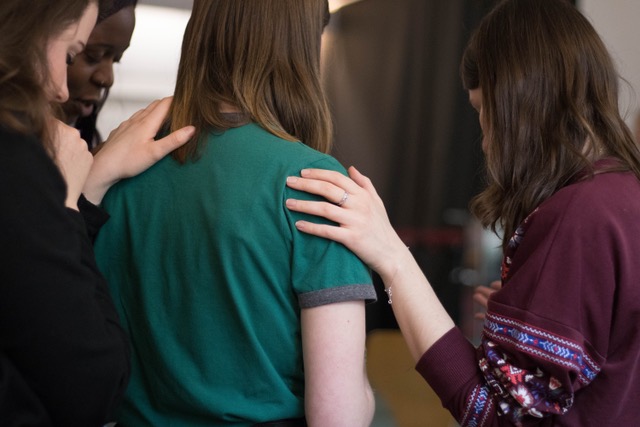
The representatives perceive the energies and thus have a serving function. It is up to them to communicate to the facilitator what their observations are. They can experience intense feelings but do not have to act them out. They just share them.
Representatives also have a steering function. They serve as a compass for the facilitator, indicating whether an intervention is appropriate or not, based on their immediate perception.
Who can be a representative?
Anyone can be a representative; no special knowledge or gifts are required. The place within the ‘knowing field’ in which the representative is placed has its own power. While each representative has their own way of expressing things, experience can play a role in accurately entering the knowing field. With more experience, a representative can become faster and more precise in their expression.
Representatives experience feelings that indicate what relationships are like. For example, a representative can just feel good, or feel wobbly, sad, or angry.
Many people like to represent because they do something for their fellow man. For example, it can already be a relief for the client to see how his representative expresses the same feelings as those that the client himself must deal with in daily life. Seeing this will not change one’s feelings, but this insight alone is liberating.
It is also possible that representatives have experiences that they do not know from their own lives, such as those of a proud great-grandmother, a war criminal, an alcoholic, etc. This can lead to other insights that would otherwise have remained hidden.
In general, the fear that the representative will bring his own experiences into the constellation is unfounded. In exceptional cases, a person can be overcome by their own emotions. Other representatives will also notice this, and the facilitator should pay attention to this.
Is it dangerous to be a representative during a family constellation?
No, in general, a participant can handle this role. It happens that a representative still suffers from the tension he/she has acquired in his/her role for some time after the position has been set up. Therefore, the facilitator must ensure that the representative consciously steps out of the role. There are different techniques for that.
I also want to participate in a family constellation Do you find this interesting, and would you like to experience a family constellation yourself as a representative, or do you have a question you would like to explore? Then sign up for the Hidden Dynamics workshop. In these workshops, we will explore (family) themes using Systemic Ritual and Family Constellations.
Tip: Another self – Netflix series To find out more about this in a visual and compelling way, I recommend the Netflix series Another Self: This Turkish series follows three women and their partners. The reason for the journey they make is the diagnosis of a serious illness with one of them. During the journey, they are introduced to family constellations. They are confronted with unresolved trauma from their family history, including murder, secrets, migrations and forbidden loves. Through systemic constellation work, it becomes clear how their family histories have influenced their lives. The series shows (with the right dose of drama and romance) how constellations can support you in finding yourself. Watch the series here.
By Susanne Hazen and Josianne Zwart (Hey Joos! Virtual assistant & projectmanager)
In March, you could already read about family constellations and what they are exactly. In that blog, you read that a family constellation is a therapeutic session in which a participant brings in an issue that he or she wants to gain clarity about. Today I will tell you more about how a family constellation works.
The preliminary talk This process always starts with a preliminary talk. Someone (‘a client’ or ‘questioner’) comes up with a certain theme or question. During this first conversation, the facilitator helps the client to come to a more toned-down question. Using facts from someone’s family history, the facilitator investigates which family members might be related to the theme.
Step one in a constellation Family members play an important role in the process. During a constellation, you will not see the client’s real family members but representatives. They do not know the family system of the questioner and can therefore take up a neutral role.
Interested in Family constellations or Systemic Ritual? During the online workshops, you can get to know Systemic Ritual at an entry-level. I’ll tell you more about systemic constellations and rituals, but we will mainly do some constellations or rituals so you can experience how it works and what it can do for you. Do you want more and live? Click here for the workshop series ‘Hidden Dynamics’. It is also possible to have an individual session. See: individual-consultation-systemic-constellations-and-systemic-ritual/ Are you a professional and do you want to learn new tools? In that case, the course in Systemic Ritual is useful for you. See: Course in Systemic Ritual. You can download the leaflet on this page.
The client places the representatives on a certain spot in the room, which determines their view. But that’s it. The client does not indicate what position the representative should take, how he or she should feel or what movement he or she should make. Representatives take a moment to ‘land’ on the spot and observe what is happening in their bodies:
Do they feel big/small, stable/unsteady?
Do they lean forward or backwards?
Are the eyes open or closed?
What views attract them?
Do certain body sensations arise, such as a lump in the throat or a feeling of pressure in the stomach?
Do certain feelings come up? And which one?
Step two: the constellation begins The facilitator supervises the process. The questioner only watches. The exchange between the representatives takes place under the guidance of the facilitator. Once the client has set everyone in place, the facilitator takes the lead. He asks how everyone is doing and what they are observing. This can also be the role of the client; this depends on the question and the client. A question can be: do the representatives experience a movement impulse? If so, then they may follow that movement. The facilitator keeps an eye on the effect. Do they feel better or worse? The system is brought into better harmony by moving representatives, bringing in other family members or performing ritual sentences and actions. The constellation is finished when all representatives feel comfortable in their new spots.
The end of the constellation At the end, the client is often placed within the constellation himself. He/she changes from being a spectator to an active participant. He then experiences the other representatives as family members. The facilitator can enhance the experience even further by saying a few essential sentences, which the client repeats. A good balance must be found. Some clients only need the insight of the constellation. Others need the full experience.
What happens after a constellation? A constellation usually does not stop here. There is a small chance that the client will step out of the door and continues as if nothing had happened. The mind quickly starts asking questions after a constellation: “What does this mean? Should I call my mother now?” These thoughts are sometimes so strong that the new image of family relations can be seriously disturbed. The advice is, therefore, not to think or talk about the constellation but to draw it out, for example. The facilitator can also give some homework to continue the constellation as some sort of ritual. The client will also not immediately be put down as a representative in the next constellation. The questioner first needs to absorb the new image of his/her own constellation. This also means that after a constellation, there will be no discussion. This could lead to rationalization too quickly. The entire process must land first.
Only a part of reality becomes visible We can assume that only a part of reality becomes visible in a constellation: that part that the questioner needs concerning the theme introduced. Realize that this reality is not fixed and that it can also change over time. But that reality is also taken seriously, as if nothing else existed at that moment.
I also want to participate in a family constellation Do you find this interesting, and would you like to experience a family constellation yourself as a representative, or do you have a question you would like to explore? Then sign up for the Hidden Dynamics workshop. In these workshops, we will explore (family) themes using Systemic Ritual and Family Constellations.
federico-giampieri-R0lftflMYPw-unsplash.jpeg
Tip: Another self – Netflix series To find out more about this in a visual and compelling way, I recommend the Netflix series Another Self: This Turkish series follows three women and their partners. The reason for the journey they make is the diagnosis of a serious illness with one of them. During the journey, they are introduced to family constellations. They are confronted with unresolved trauma from their family history, including murder, secrets, migrations and forbidden loves. Through systemic constellation work, it becomes clear how their family histories have influenced their lives. The series shows (with the right dose of drama and romance) how constellations can support you in finding yourself. Watch the series here.
By Susanne Hazen and Josianne Zwart (Hey Joos! Virtual assistant & projectmanager)
Over the past months, I have already shared a lot about family constellations and Systemic Ritual. In this blog, it is time to find out what family constellations actually are and where this form of alternative psychotherapy comes from. I will go into more detail on this in the coming months.
A family is a system You, as a person, are part of a family – a system – through biological, legal, affectionate, geographical and historical ties.
According to the founders of systemic therapy, human problems are problems that arise between people who are members of this system. The underlying idea is that if one of the members of a system (a family or partner relationship, for example) has a problem, the entire system is disrupted. The other way around: the system can help an individual by strengthening that system in which he or she lives.
Interested in Family constellations or Systemic Ritual? During the online workshops, you can get to know Systemic Ritual at an entry-level. I’ll tell you more about systemic constellations and rituals, but we will mainly do some constellations or rituals so you can experience how it works and what it can do for you. Do you want more and live? Click here for the workshop series ‘Hidden Dynamics’. It is also possible to have an individual session. See: individual-consultation-systemic-constellations-and-systemic-ritual/ Are you a professional and do you want to learn new tools? In that case, the course in Systemic Ritual is useful for you. See: Course in Systemic Ritual. You can download the leaflet on this page.
paolo-bendandi-s8Wrjl8-AeY-unsplash.jpeg
What is the origin? The method of family constellations – based on other systemically oriented methods – was developed in Western Europe by the German Bert Hellinger. His working method is so-called systemic work:
By setting up someone’s system of origin, you can recognize, acknowledge and possibly eliminate relationships between family members that are not immediately visible. You can also identify, acknowledge and eliminate possible bottlenecks.
So what is a family constellation? A family constellation is a therapeutic session in which a participant brings in an issue that he or she wants to get clarity on. Such an issue often originates in hidden dynamics that play a role between various family members of the person who raises the issue. During a constellation, other participants are selected as ‘representatives’, but more about that in another blog. The questioning participant places the representatives on certain spots in the room. Those spots are chosen in relation to the other representatives and the questioning participant. He/she is partly helped by the facilitator – the supervisor of the constellation.
The representatives are questioned about their feelings and attitudes towards each other and the situation. In this way, the mutual relationships and unconscious processes that play a part between people are made visible.
For example, entanglements (often from previous generations) that have led to stagnation in the participant’s current life come to light. These are often unprocessed feelings as a result of unpleasant events such as the young death of a parent or child, a war experience or the divorce between parents. Children who are born later, can unconsciously and unintentionally take on those unprocessed feelings, causing them to be out of balance.
In this context, people sometimes talk about family soul, family consciousness or family karma. A constellation makes visible what is happening in a family soul.
What happens during a family constellation? During a family constellation, representatives are physically placed on a certain spot in the room, but more happens during such a constellation:
Relationships and processes are made visible.
The participants look for the origin of the problem, by searching for the individuals from previous generations who had every reason to be anxious, sad or angry.
A new, more harmonious balance is created.
“I feel lighter” You restore balance through ritual sentences and/or actions. After a constellation, the person asking the question can feel the effect for years to come. The problem he came up with might disappear. This can even affect the family members who are unaware of the setup: family members have suddenly contacted again, or contact between them goes smoother.
Tip: Another self – Netflix series To find out more about this in a visual and compelling way, I recommend the Netflix series Another Self: This Turkish series follows three women and their partners. The reason for the journey they make is the diagnosis of a serious illness with one of them. During the journey, they are introduced to family constellations. They are confronted with unresolved trauma from their family history, including murder, secrets, migrations and forbidden loves. Through systemic constellation work, it becomes clear how their family histories have influenced their lives. The series shows (with the right dose of drama and romance) how constellations can support you in finding yourself. Watch the series here.
federico-giampieri-R0lftflMYPw-unsplash.jpeg
Does this sound interesting? In the online workshops, you can easily become acquainted with this work: I will tell you more about systemic constellations and Systemic Ritual, but we will mainly do some constellations or rituals, so that you can experience how it works and what it does to you. Do you want more and live? Then there is the workshop series ‘Hidden Dynamics’ – in Amsterdam. It is also possible to have an individual session. See: individual-consultation-systemic-constellations-and-systemic-ritual/ Are you a professional and do you want to learn new tools? In that case, the course in Systemic Ritual is useful for you. See Course in Systemic Ritual. You can download the leaflet on this page.
By Susanne Hazen and Josianne Zwart (Hey Joos! Virtual assistant & projectmanager) Photo: tyler-nix-V3dHmb1MOXM-unsplash.jpeg
In previous blogs, I described situations in current relationships and from previous relationships that impact your current relationship. Today I will discuss the last part: what happened in the family of origin that affects the current situation?
Intergenerational trauma Intergenerational trauma is a concept developed to help explain long-standing destructive patterns within families. It means the transfer or the transmission to younger generations of oppressive or traumatic effects of a historical event that took place with ancestors. This involves loyalty to and identifications and entanglements with people in the generations before you. I speak of ‘family karma’. Read more about that on this page.
annie-spratt-Ar9j8V6oMzo-unsplash.jpeg
Do you want to know more about how to break free from a previous relationship? Or are there events in your current relationship that you want to work on? During the online workshops, you can get to know Systemic Ritual at an entry level. I’ll tell you more about systemic constellations and rituals, but we will mainly do some constellations or rituals so you can experience how it works and what it can do for you. Do you want more and live? Click here for the workshop series ‘Hidden Dynamics’. It is also possible to have an individual session. See: individual-consultation-systemic-constellations-and-systemic-ritual/ Are you a professional and do you want to learn new tools? In that case, the course in Systemic Ritual is useful for you. See: Course in Systemic Ritual. You can download the leaflet on this page.
paolo-bendandi-s8Wrjl8-AeY-unsplash.jpeg
Commitment Commitment is an essential part in relationships. Commitment is connected to the energy we give to something or someone or a certain value. Think of an important family value. For example, the value of freedom may be more important than the commitment to a partner.
You often see this with women from strict cultural backgrounds where women have to be submissive to men for many generations. Their mantra now is: “I won’t end up like this”. This value can be more important than the relationship with a man.
In every relationship, a piece of freedom is ‘given up’, but that is unacceptable in the example above. In this case, there is a commitment with all ancestral women who did not know freedom.
If a person shows no commitment to the partner, then his/her commitment is to something or someone else. And this has an impact on your relationship.
Intergenerational socio-cultural traumas In addition to the impact of situations from our personal lives and from the lives of our parents and ancestors, socio-cultural historical traumas also impact relationships.
Such traumas include war, famine, immigration, slavery, genocide, colonialism, political unrest, disasters, economic collapse and radiation.
The impact of these events creates the dynamics of our relationships. We carry the past in our bodies in the present. These forces guide our choices until we are aware of them. Each country has its own history and, therefore, a different dynamic that can play a role in relationships.
It is sometimes said in shamanistic cultures that up to and including the 7th generation descendants still deal with the entanglements of ancestors. And this concerns traumas from the personal lives of those ancestors. When it comes to sociological, cultural, religious or political trauma, the impact can last for centuries.
Healing Healing intergenerational traumas is the essence of the Family Constellations and Systemic Ritual method. In a constellation, you look for the cause of the problem. You look for people in previous generations who had every reason to be sad, anxious, angry, etc. In this way, you ‘expose’ the cause of the problem. You restore it through ritual phrases and/or actions and/or adding other ancestors who can help.
Tip: The other self – Netflix series To find out more about this in a visual and compelling way, I recommend the Netflix series The Other Self: This Turkish series follows three women and their partners. The reason for the journey they make is the diagnosis of a serious illness with one of them. During the journey, they are introduced to family constellations. They are confronted with unresolved trauma from their family history, including murder, secrets, migrations and forbidden loves. Through systemic constellation work, it becomes clear how their family histories have influenced their lives. The series shows (with the right dose of drama and romance) how constellations can support you in finding yourself. Watch the series here.
federico-giampieri-R0lftflMYPw-unsplash.jpeg
Do you want to know more about how to break free from a previous relationship? Or are there events in your current relationship that you want to work on?
During the online workshops, you can get to know Systemic Ritual at an entry-level. I’ll tell you more about systemic constellations and rituals, but we will mainly do some constellations or rituals so you can experience how it works and what it can do for you. Do you want more and live? Click here for the workshop series ‘Hidden Dynamics’. It is also possible to have an individual session. See: individual-consultation-systemic-constellations-and-systemic-ritual/ Are you a professional and do you want to learn new tools? In that case, the course in Systemic Ritual is useful for you. See Course in Systemic Ritual. You can download the leaflet on this page.







 Systemic Ritual and Systemic Constellations